Thursday, February 22, 2007

Google Takes An LP Approach In India; Invests In Erasmic And Seedfund

Google is taking an LP approach in India as to investing. The Mountain View-based search giant has invested in two early stage or seed stage funds - Bangalore-based Erasmic Venture Fund and Mumbai-based Seedfund. The amount of investment in both firms is undisclosed.
"While the rush of large amounts of venture capital into India is well-documented, very little of this trickles down to small firms - the early-stage startups. Our effort is to build this gap by investing in these funds,"
said Samir Sood, head (corporate development - South Asia), Google.

Apparently, India is the first country where Google has made a limited partner investment in early stage funds. These funds would essentially look at product innovations in consumer, Internet and mobile services.

New Enterprise Associates Appoints Ben Mathias As VP Of Indian Operations; To Invest $200 Million In India

US venture capital firm New Enterprise Associates has announced that it will invest $200 million in Indian technology sector. The fund has appointed Ben Mathias as Vice President of the Indian operations - under the entity New Enterprise Associates (India) Pvt. Ltd. Mathias will work closely with NEA’s US-based technology team. NEA has $8.5 billion in committed capital across 13 funds.
“We have been selectively investing in India for many years and believe the country offers an attractive environment for venture investing,”
said Peter Barris, NEA Managing General Partner.

The fund has investments in Sasken Communications, Telsima, Nevis Networks, Protostar, InSilica and GlobalLogic. NEA also has 20 per cent stake in NEA-IndoUS Ventures, an early venture capital fund started by Vinod Dham and Vani Kola. NEA will invest in early-stage IT investments indirectly through NEA-IndoUS Ventures. NEA’s direct investments will be primarily in mid to late-stage opportunities.

“NEA’s focus in India will be on expanding its investment portfolio, while making returns on our initial investments. We look forward to working with India’s best and brightest entrepreneurs in telecom, media, alternative energy, technology-enabled services and infrastructure,”
said Krishna “Kittu” Kolluri, General Partner.

“Our US-based team which also includes Mark Perry and Ravi Viswanathan, will be
consulting with Ben Mathias (head of Indian ops) to identify opportunities..."

Chrys Capital Sells Global Vantedge To Essar Group's Aegis For $22.5 Mn

It's official now. The Essar Group-owned Aegis has acquired BPO firm Global Vantedge for Rs 100 crore or $22.5 million. Global Vantedge, a 75 per cent of which is owned by private equity fund Chrys Capital, is a US-based credit and receivable management BPO.

Set up in 2001, Global Vantedge employs 1,400 people at in Gurgaon, San Jose and Costa Rica. It has operations in the banking, telecom and automobile verticals. The acquisition is the fourth by Aegis in the past one year. Global Vantedge will add over $25 million in revenues to the BPO business of the group. Aegis is scouting for more buys in the US.

It had earlier acquired Customer First and Orion in India and Technion in the US. In November 2003, Essar and Deutsche Bank had bought 80 per cent stake in Texas-based Aegis for $28 million. Later, the Essar group increased its stake in the company. Last year, Essar delisted Aegis Communications Group (ACG) from over-the-counter bulletin board (OTC BB) of Nasdaq at an equity valuation of $57.4 million.

GVFL Makes Seed Investment Of Rs 8 Million In RapidRadio

Venture capital fund GVFL Ltd has made a seed investment of Rs 8 million ($180,000) in RapidRadio Solutions Pvt. Ltd, a technology start-up spun off from the NirmaLabs incubator program. RapidRadio, set up in 2005, works in the area of RFID (Radio Frequency iIdentification) technology.

Rapid Radio is the sixth investment from the Rs 270 million Gujarat IT Fund of GVFL. Its previous investments include Net4Nuts, Ecube, Icenet, Anupam Globalsoft and Convergelabs from the fund. Rapidradio is GVFL’s first investment in a start-up from an academic incubator program.
“The RapidRadio investment is a new milestone in our endeavor to provide critical seed stage and early stage funding to innovative start-ups that are poised to take knowledge based test-marketed ideas into commercial production. We are now stepping forward into campus incubation programmes to identify and nurture promising ideas and entrepreneurs,”
said Vishnu Varshney, CEO of GVFL Ltd.

Dhaval Kotecha is the CEO of RapidRadio , a friend of mine! Congratz Bro!

Wednesday, January 31, 2007

Global Outsourcing to Become Main Form of IT Delivery by ‘12 – Forrester

According to a research conducted by Forrester, outsourcing will become main form of IT delivery by 2012. In addition, Indian companies are likely to overshadow the multinational firms in the application outsourcing domain. Among the key findings, more Americans are likely to offshore their work in the near future.

The Indian outsourcing firms such as TCS, Wipro, and Infosys had posted an increase in revenues in the range of about 40 percent to 50 percent. According to another research firm, Technology Partners International, the Indian vendors own just 6 percent of the global outsourcing market in 2006. In addition, the US companies are only spending about 1.9 percent of their outsourcing budgets on offshore services.

However, at present, the Indian firms are gaining with global firms relying on third-party vendors to optimize and streamline their businesses. The application outsourcing services have materialized as a highly strategic business. It has also become difficult to sell various IT and BPO services, which are prompting a huge investment.

Monday, January 22, 2007

Venture capitalists slowing down?

Venture capital investment into U.S. companies slowed markedly in fourth quarter of last year, to the slowest pace in two years.


That drop-off wasn’t enough to knock 2006 from its status as most robust year since 2001, however — and it’s too early too tell whether the slow-down will continue into this year.For all of 2006, investors backed 2,454 companies, slightly ahead of 2005’s level. Total investment was $25.75 billion, an 8 percent increase over the preceding year, according to the quarterly survey by Ernst & Young and Dow Jones VentureOne.

The surprise is the fourth quarter, when VCs backed 561 deals and invest $5.82 billion, drops of 13 percent and 2 percent, respectively, from the fourth quarter of 2005.
This comes at the same time venture capital firms slowed their own fund-raising from their investors to the slowest pace in three years, according to Thomson Financial data released last week.

Trends in Silicon Valley reflected the slowdown seen in the rest of the nation. VCs invested $1.94 billion in local companies, down from $2.12 billion the same quarter of 2005.
See diagram below, which suggests the interactive Web companies (dubbed Web 2.0) were among the few sectors to grab more money in the fourth quarter compared to the third quarter. The classifications aren’t perfect, but see “consumer/business services” and “media/content”, for example.
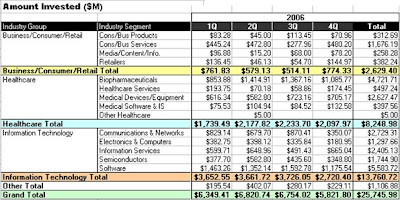

But if you stand back, and look at 2006 year as a whole, investments increased across each of the three main industries tracked

(a) healthcare,
(b) IT and
(c) consumer and business products and services, so this a broad recovery.
Within IT, though investments fell in the sub-category of chips.

The clear winner was alternative energy, where investments boomed 190 percent, compared to the year before.

Highlights:

–Healthcare in 2006 — 628 companies were invested in; 5% increase from 2005
–11.3% drop in communication & networking in 2006
–14% increase in electronics & computing
–27.5% increase in information systems
–6.6% drop in semiconductors
–1.8% increase in software
–Alternative Energy in 2006 - $537.6 million in 41 companies; 190% increase from 2005

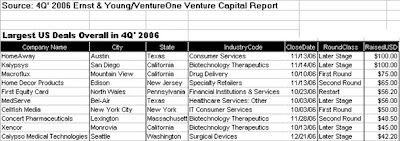
The biggest deals are listed in a table at bottom.
Meanwhile, data suggests that less money can sometimes be better, according to the number-crunchers at Bridgescale, a new Silicon Valley venture firm (see Venture Beat story here). The firm used VentureOne statistics and other sources to track IPOs and mergers and acquistions. Companies funded by angels initially take in three rounds of venture capital, on average, instead of four, they found. This suggests these angel-backed companies are more efficient. Indeed, these angel-backed companies ended up taking $15 million less money from investors than other companies did before their exits — or $50 million, versus $65 million.

Finally, these companies accounted for $700 million in total investments, but led to $10 billion in exit value, a 15-fold return, Bridgescale found. That compares to $2 billion invested, and a $13 billion exit value for other companies, or a 6-fold return.


Source Feed: VentureBeat

Friday, January 19, 2007

Hyperactive Mike Moritz


Moritz, the most prominent partner at Silicon Valley's leading venture capital firm, made at least ten investments last year, according to Venture Capital Journal.


The Sequoia Capital VC, who might have been expected to rest on his laurels after the stratospheric return on his Google investment, put at least $230m to work, the Thomson Financial database shows. Why? Moritz, unlike John Doerr of Kleiner Perkins, doesn't seem inclined to save the world just yet. If the investor, a former journalist, is to establish himself as a Valley legend, he'll need a follow-up after the grand slams of Yahoo and Google.

But there could be a simpler explanation for Moritz's hyperactivity: most investors struggle to win the approval of fellow partners; Moritz's belief in Larry Page and Sergey Brin's search engine provided so much of the firm's recent returns that no other Sequoia partner dares question his investment ideas.

VC Deals Today

Workshare, a London-based provider of secure content compliance solutions, has raised $23 million in Series B funding. Backers include Steelpoint Capital Partners, Intel Capital and Quester. www.workshare.com

Player X, a UK-based mobile gaming and entertainment company, has raised Gbp5 million in second-round funding. Nordic Venture Partners and Long Acre Partners were joined by previous backer Arts Alliance. www.playerx.com

Chegg.com, a Santa Clara, Calif.-based online marketplace for college students, has raised $2.2 million in Series A funding from Gabriel Venture Partners and seed backer Mike Maples. The news was first reported by BusinessWeek. www.chegg.com

InovaWave Inc., an Austin, Texas-based maker of software that improves server and desktop virtual machine performance, has raised $2 million in Series A funding from Silverton Partners. www.inovawave.com
Building Materials Corporation of America has raised its offer for Dallas-based roofing and building products company ElkCorp (NYSE: ELK) from $40 per share to $42 per share. This is now the second time that BMCA has topped an offer from The Carlyle Group, which originally bid $38 per share and later upped it to $40.50 per share. UBS is running the auction. www.elkcorp.com www.carlyle.com

Claros Diagnostics Inc., a Woburn, Mass.-based developer of handheld urological cancer diagnostic testing system for point-of-care use, has raised $7.8 million in Series A funding. Oxford Bioscience Partners led the deal, and was joined by Bioventures Investors, Accelerated Technologies Partners and Commons Capital. www.clarosdx.com

Scott Darling has joined Frazier Technology Ventures as its fifth partner. He has spent the past seven years with Intel Capital, and 17 years overall with Intel Corp. www.fraziertechnology.com